Reopening of the Vienna Actionism Museum – Hermann Nitsch 29.01.2026
Reopening of the Vienna Actionism Museum – Hermann Nitsch

Hermann Nitsch
Schüttbild (Kreuzwegstation), 1960
185 x 300 x 2,4 cm
Blood, paint on burlap
© VG Bild-Kunst, Bonn 2026
Photo: Archive Viehof Collection

In mid-March 2026, the Vienna Actionism Museum will reopen after renovation, expansion and modernisation. The museum is dedicated to the radical art movement of Viennese Actionism, which emerged in the 1960s and 1970s. Artists such as Hermann Nitsch, Günter Brus, Otto Muehl and Rudolf Schwarzkogler are among the most important representatives of the movement, which is considered Austria's most significant contribution to 20th-century art. The starting point was radical materiality and a deep rootedness in the social upheaval of the 1960s. The canvas was no longer understood merely as a surface for painting, but as a space. Instead of paints, ‘real’ substances such as food, excrement, blood and animal carcasses were used to force immediate, often shocking physical experiences. The boundaries of norms and themes of identity were renegotiated, often with radical use of one's own body as a place of freedom. The movement saw itself as a ‘liberating blow’ against Austrian post-war society, which was perceived as rigid and outdated. 

The opening exhibition of the reopening is dedicated to the early work of Hermann Nitsch and is supported by the Viehof Collection with a total of three loans.


Sabine Moritz in the Viehof Collection 16.01.2026
Sabine Moritz in the Viehof Collection

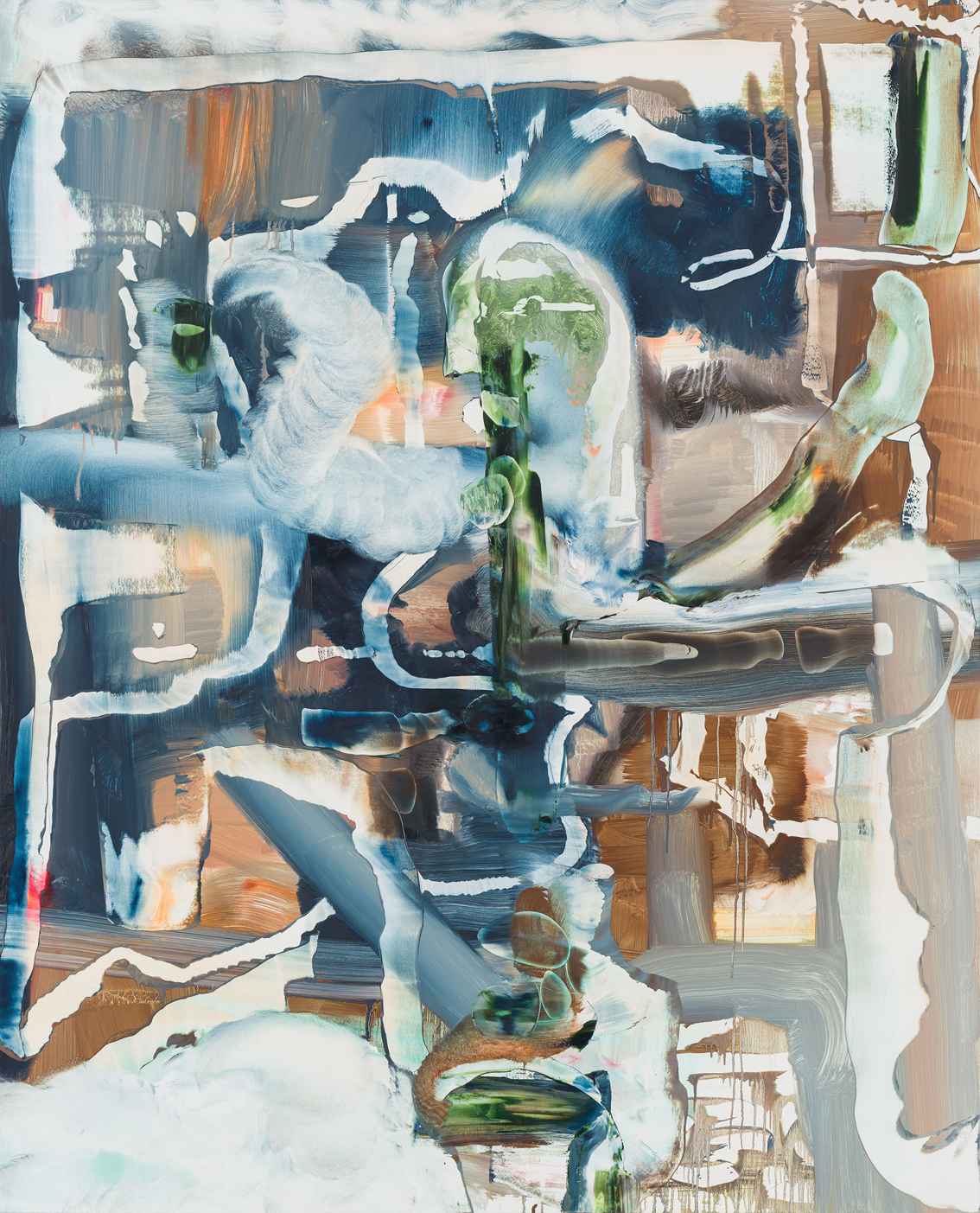
Sabine Moritz
Columbus, 2025
200 x 200 cm 
oil on canvas

photo: Farbanalyse
© the artist // Courtesy of the artist and Pilar Corrias, London

The most recent addition to the Viehof Collection is a work by Sabine Moritz, expanding the list of female artists by one. 

The work ‘Columbus, 2025’ shows a dense network of gestural, overlapping brushstrokes in bold, sometimes contrasting colours. The composition appears deliberately open and non-hierarchical: there is no central motif, but rather an all-over field in which forms are suggested and then dissolve again. In terms of painting technique, the work combines expressive, almost impulsive gestures with controlled colour transitions. The visible brushstrokes and the juxtaposition of transparent and impasto areas create depth without asserting an illusionistic space. The title refers less to a concrete representation than to the motif of ‘discovery’ – understood as an ambivalent, historically burdensome act. Layers of paint cover each other, lines push forward and break off again. Instead of clearer orientation, a visual terrain emerges that is constantly in motion. Thus, ‘Columbus’ exemplifies Moritz's approach of not formulating historical or conceptual references narratively, but rather translating them into an open, painterly structure.


Arnuf Rainer (1929 - 2021) - An obituary 01.01.2026
Arnuf Rainer (1929 - 2021) - An obituary

Arnulf Rainer
Schwarze Übermalung 1960
oil on canvas
50 x 70 cm

© Arnulf Rainer
Photo: Archive Viehof Collection

Arnulf Rainer, who is represented in the Viehof Collection with four works, passed away on 18 December 2025.

Rainer is one of the most important Austrian artists of the post-war period and a central figure of international modernism. Born in Baden near Vienna, the artist became known primarily for his overpaintings, in which he reworked existing paintings, photographs or self-portraits with gestural, often dark traces of colour. In doing so, he radically questioned traditional notions of beauty, perfection and authorship.

His art is strongly influenced by existential themes such as pain, death, spirituality and inner tension. Rainer understood painting less as a representation of the external world and more as an expression of inner states. This attitude made him an important link between Informel, Abstract Expressionism and Conceptual Art. He had a major influence on subsequent generations of artists and was exhibited internationally. His work is groundbreaking because it redefined the boundaries of painting and placed the artistic act itself at the centre.

Femal artist of the Viehof Collection 31.07.2025
Femal artist of the Viehof Collection

Louise Lawler 
Hotel Room, Köln, 1989/2014
© Louise Lawler 
Courtesy: the artist / Galerie Sprüth Magers, London

With the recent acquisition of a work by Louise Lawler, another name has been added to the list of female artists.

Since the 1970s, the American conceptual artist has been critically questioning the mechanisms of the art world in her work. She is best known for her photographs, which show artworks not in museums or galleries, but in private collections, warehouses, at auctions or in hotel rooms. In doing so, she draws attention to the context in which art is presented, owned and consumed. Lawler's works raise questions about authorship, the value of art and the role of institutions. Her precise, often ironic gaze reveals how strongly the meaning and perception of art is shaped by its social and economic context. In her works, Lawler shows that art is always perceived in a context that influences its perception.

Highlights from the Viehof Collection 04.02.2025
Highlights from the Viehof Collection

Thomas Struth

Einzelner Löwenzahn – N° 37, Düsseldorf,
Neanderstraße 25 1993, 1993, C-Print, 39,2 x 57,8 cm

© Thomas Struth, 2025

In 2008, the Viehof Collection was able to acquire a very special group of photographic works. These are the 101 C-prints from the Winterthur series by Thomas Struth. The Viehof Collection is the only art collection in the world to hold so many works from this series. The flower paintings and landscapes by Thomas Struth were created between 1991 and 1993. They were commissioned for patients rooms in a private clinic in Winterthur, Switzerland. The Viehof Collection is the only art collection in the world to include all 101 artworks from this series.

Sea of flowers and landscapes – nothing but nature as far as the eye can see. Ones first thought is that this is rather simple, trivial subject matter; after all, our culture today considers plant and flower motifs to be primarily decorative. The artworks are intended to be like windows, opening up the space and connecting patients‘ rooms to a living cosmos. They are not simply décor. In his flower pictures, created by photographing from close proximity, from different angles, and sometimes using overexposure or underexposure, Struth is not interested in portraying perfection. Instead, the theme of these photographs is a fantastic living diversity that – like the patients living in the rooms – are not in a state of stable equilibrium, but within the flow of time. Struth sometimes shows us closed buds, wilting flowers, crooked branches, or dried leaves. The flowers and landscapes are not intended simply to please the eye. Nor is this a schematic arrangement of botanical classifications. If it were, then the sole dandelion flower in Einzelner Löwenzahn – N°37, Düsseldorf, Neanderstraße 25 1993 would have to be seen as a representative of all existing dandelion flowers. On the contrary, Struth is concerned solely with this individual flower, with its peculiar characteristics. The flower is portrayed here heavily magnified, authentically, as a fragile individual. The concrete location in the title serves to emphasise this.

Text: Annika Forjahn, in: Freischwimmer - Fotografie der Sammlung Viehof und des Museum Kurhaus Kleve, 2020, S. 88-97


New acquisitions 02.11.2024
New acquisitions

Sebastian Riemer
Archer (Tenney)
150 x 127 cm
Pigment Print

Copyright: Sebastian Riemer

With one of its latest acquisitions, the Viehof Collection is adding photography to its list of artists. Since 2006, Düsseldorf-based artist Sebastian Riemer has repeatedly developed series that thematize, illuminate and question the documentary claim of photography. In his Press Paintings series, the artist deals with historical photos from press agencies that were mostly retouched with the help of paint in the analog age. The originals he selects in a lengthy search process are meticulously analyzed and individually edited. The intervention does not take place in the motif itself. Through the high-resolution enlargement, which leads to a shift in perception and detachment from the original context, coincidences are emphasized and new approaches are generated.

Riemer explains: "It is really importand to me to show the materiality and the signs of age of the prints very clearly so I use the photographic prozcess to make this visible by enlargement. But I also want to give back a kind of dignity to the photographed persons ans subject matters that hat been altered in so many ways. Some of them were altered cruelly on the pictorial level. So, I often choose a size that is very close to life-size of the depiction, emphasising the gap between the image content of the vintage prints and the partial new image content of the unintended parts (the retouching ans signs of ageing) Also the sometimes very arrucate miniature retouching looks "clumsier" in enlargement, suggesting the bold brush strokes form the field of fine art rather than the origin as applied craft. Moreover, I like to look at this process of stark entlargement like unearthing peudo frescos from an ancient time of image making. Size really makes the differences here."

Sebastian Riemer in conversation with David Campany, in: Sebastian Riemer, Press Paintings, p. 283

Three new acquisitions 07.03.2024
Three new acquisitions

Jongsuk Yoon
Kumgangsan, 2021
Oil on canvas, 195 x 350 cm
Courtesy: the artist [&] Galerie nächst St. Stephan
© The artist

Jongsuk Yoon - Encounter of two worlds

In the large-format paintings of the Korean-born, Düsseldorf-based artist, the tradition of European landscape painting meets the Asian style of painting in a rich contrast. The color fields, which sometimes overlap in transparent lightness, are sometimes applied smoothly, sometimes with clearly visible brushstrokes, creating dreamlike landscapes that have no content other than themselves and thus tell no story. In Jongsuk Yoon's paintings, time stands still, making them a places to linger. Three landscape paintings have now been purchased for the Viehof Collection, including the work entitled "Kumgangsan", which is named after a mountainous region within the Taebaek Mountains on the east coast of North Korea and the border with South Korea and refers specifically to the artist's roots.


New acquisitions 27.02.2024
New acquisitions

Meuser 
Windhose / Stahl, Ölfarbe / 160 x 70 x 70 cm

Photo: Wolfgang Günzel
Courtesy: Galerie Bärbel Grässlin, Frankfurt a.M., und Meuser

Meuser

The Viehof Collection, to which around 1,500 works are currently affiliated, continues to pursue the continuous expansion. In doing so, the collector family aims not only to acquire artists on a one-off basis, but also to follow up on their oeuvre and to add to earlier works and fill gaps as required.

In addition to the first acquisition of works by artists such as Sarah Morris and Jongsuk Yoon, the Meuser portfolio was also supplemented with a current work at the beginning of 2024. The first acquisitions of Meuser's works took place in the early 2000s. The existing 10 artworks has now been expanded to include the work "Windhose" from 2020.


Large sculpture by Andreas Schmitten at Frankfurt Airport station 07.06.2024
Large sculpture by Andreas Schmitten at Frankfurt Airport station

Andreas Schmitten
IMMATERIELLES
Copyright: Andreas Schmitten
Photo: ARCHIV SAMMLUNG VIEHOF

Around 33,000 travelers pass through Frankfurt Airport's train station every day, making it the largest airport station in Germany. On 6 June 2024, the over five-metre-high sculpture IMMATERIELLES by Andreas Schmitten was unveiled here. Immaculately lacquered in white, the head, supported by three hands, rests above the stream of people constantly dispersing in all directions. With its curved, organic forms, the sculpture forms a contrast to the static, geometric structure of the station architecture, reminding us that in this functional, functional building with its technology and the most automated and controlled processes possible, the focus is still on the human being with its need for closeness, interaction and physicality.

Schmitten's work is the second sculpture in the station culture series “Station to Station”, which is initiated by the federal government in collaboration with Deutsche Bahn and the Foundation for Art and Culture.


Frankfurt Flughafen Fernbahnhof | Ebene 3
Hugo-Eckener-Ring, 60549 | Frankfurt am Main

--> Project Station to Station


Dieter Nuhr 15.07.2021
Dieter Nuhr

Dieter Nuhr 
Skye 01, 2018 / Photo on textile / 60 x 60 cm
Courtesy by the artist [&] Galerie Löhrl


A new position for the Viehof Collection

More than 20 works by Dieter Nuhr are now in the private possession of the Viehof family. This konvolut, which has been expanded over the past few years and finely selected from various groups of works, will now officially be made available to the collection.

Dieter Nuhr has long been one of Germany's best-known satirists. In contrast, probably only a few people know that after studying art with a focus on painting, he devoted himself to photography. The works are created on his travels through remote and exotic places around the world, which Nuhr captures in an almost archival manner.

"In the course of my exploration of living space while traveling, I make a picture of the world. To look around, to see, to experience, to archive, there is the meaning of traveling as of life. We move through time and space, experience, act and remember," says Dieter Nuhr.

But Nuhr's photographs are more than snapshots of places and objects. Through subjectively chosen cropping and image composition, the artist creates independent images, detached from the material context, that seem closer to abstract painting than to photography. Nuhr refers to this transformation as "digital painting." The photographic work becomes more than a mere image. Poetically charged, Nuhr's images combine what is seen with subjective memories and ideas. Image of reality, real materiality and intangible unreal interact.

The artist explains, "A picture is a reflection surface. The image of the landscape is the occasion for conscious perception and association. What the viewer takes away from the picture and what thoughts he develops is up to him. Art is always just a suggestion."


New installation for David Zink Yi's "Independencia I" 19.08.2018
New installation for David Zink Yi's "Independencia I"


Installation view, Langen Foundation 

David Zink Yi, Independcia I, 2005

Foto: Archiv Sammlung Viehof 

The title Indepencia I of the installation by Peruvian artist David Zink Yi refers to the independence of the right from the left hand required to play the Cuban Batá drum. Originally introduced by Nigerian Yoruba slaves, the instrument consists of a lengthy hollow wooden cylinder the left side of which is usually used to give the beat while the melody is played on the right side. It is believed that a divine entity jumps from side to side inside the drum in order find the right rhythm.

The large wooden box created especially on occasion of the Polyphon exhibition at Langen Foundation, allows the visitor to enter the box in order to look at two video projections on each site showing men shot from behind. While one rows through the sea and the other cycles along the Malecón promenade in Havana, they both re-tell the story of the Batá drum. In this way the visitor takes on the role of the spirit, activating the installation through their presence.

With the exhibition now drawing to an end, the Viehof Collection has decided to maintain the structure in order to be able to lend it together with any future loans of the installation.

The exhibition catalogue for the show at Deichtorhallen 14.02.2021
The exhibition catalogue for the show at Deichtorhallen

Cover: Norbert Schwontkowski, 4 Gespenster enthüllen ein Denkmal, 2005 (c) The estate of Norbert Schwontkowski

Deichtorhallen Hamburg presents one of the most significant German private collections of contemporary art at two locations, the Hall for Contemporary Art and the Falckenberg Collection in Hamburg-Harburg. The Viehof Collection, which includes important works from the Speck Collection and the Rheingold Collection, brings together over 950 works in painting, drawing, photography, sculpture, installations, and video with an emphasis on German art from the post-war era to today. Both catalog and exhibition focus on outstanding groups of work by individual artists including Georg Baselitz, Joseph Beuys, Candida Höfer, Jörg Immendorff, Sigmar Polke, Daniel Richter and Rosemarie Trockel.

This comprehensive exhibition in Hamburg, put together entirely from the works of the collection and curated by Dirk Luckow, reveals for the first time the extraordinary range of this collection in an overview of Minimalism, represented by names such as Carl Andre and Dan Flavin, via the 1980s in Cologne defined by Walter Dahn, Georg Herold, Martin Kippenberger and Albert Oehlen, the Düsseldorf School of Photography with Struth, Ruff and Sasse right up to the promising field of figurative art of the 21st century showcasing works by André Butzer, Peter Doig, Thomas Houseago, Jonathan Meese, Neo Rauch, Tal R, Corinne Wasmuth and many others.

The bilingual catalogue (German/ English) is avaliable at Snoeck Verlag for 58,00 Euros. Published by Dirk Luckow with essays by Philipp Kiaser, Dirck Luckow, Susanne Titz, Wolfgang Ulrich et al. as well as short texts on particular collecting areas. 360 pages, 410 illustrations in colour.

Check out the catalogue

Order the catalogue on the publisher's website


Exhibition:
Deichtorhallen Hamburg/Sammlung Falckenberg Hamburg-Harburg, 1.10.2016 – 15.01.2017